149030 stories
·
1 follower

Alternative counterintelligence analyses of the 9/11 Attacks and the declassified PDBs

1 Share

Alternative counterintelligence analyses of the 9/11 Attacks and the declassified PDBs

AI Mode reply for Alternative counterintelligence analyses of the 9/11 Attacks and the declassified PDBs

The massive release of declassified

(PDBs) and related CIA documents significantly alters the retrospective counterintelligence (CI) lens on the September 11 attacks.

For decades, the standard paradigm established by the

9/11 Commission Report

framed 9/11 primarily as an "intelligence failure" rooted in a "lack of imagination" and a breakdown in agency-to-agency information sharing. However, the declassification of 71 PDB products—spanning from 1997 to 2001—fuels alternative counterintelligence analyses that pivot away from simple bureaucratic incompetence toward more acute systemic vulnerabilities.

These alternative CI frameworks focus on structural blind spots, aggressive al-Qaeda deception strategies, and the ongoing debate over executive actionable warning.


1. The "Long and Loud Warning" vs. Policymaker Inaction

The newly declassified PDBs heavily arm an alternative framework championing the intelligence community’s performance while scrutinizing policy-level failure.

  • The "Aircraft as a Weapon" Threat Matrix: A newly declassified brief from September 1998 explicitly warned President Bill Clinton that Osama bin Laden's preferred option was a strike on U.S. soil, specifically cautioning that al-Qaeda "may fly an explosive-packed airplane into a US city". Subsequent briefs detailed al-Qaeda operatives experimenting with chemical agents, conducting dry runs to bypass U.S. airport security, and actively training for commercial hijackings.
  • The CI Implication: This dismantles the historical narrative that using planes as missiles was completely unimagined by analysts before 9/11. Under this analysis, the failure was not the generation of strategic intelligence but the "paradox of prevention." Analysts provided consistent, high-frequency warnings, but policymakers failed to implement defensive domestic countermeasures because the alerts lacked tactical coordinates (exact times and flight numbers).

2. Al-Qaeda as an Intelligence and Counterintelligence Actor

Traditional histories treat al-Qaeda as a radicalized, non-state asymmetric threat operating on fanatical devotion. Alternative academic and counterintelligence analyses reframe the group as a highly disciplined intelligence outfit that successfully executed a hostile denied-area operation.

  • Active Operational Security (OPSEC): Al-Qaeda utilized sophisticated counterintelligence measures to blind the U.S. Intelligence Community (IC). According to academic CI reviews, the hijackers weaponized Western open-source data to map structural vulnerabilities, adopted Western lifestyles to blend into domestic populations, and adhered to rigorous, compartmented communication silence.
  • Exploiting the Law Enforcement Bias: Al-Qaeda recognized that the FBI treated terrorism through a retrospective, law-enforcement lens (building criminal cases after an event) rather than a forward-looking counterintelligence or preventative paradigm. By launching an operation entirely within U.S. borders using legal visas, they slipped into a jurisdiction where the CIA was legally barred from operating and the FBI was culturally ill-equipped to track them proactively.

3. The Structural Blind Spots: Human Intelligence (HUMINT) Deficits

Alternative CI critiques point to a profound institutional rot regarding how the CIA and FBI cultivated assets in the late 1990s.

  • The Vulnerability in the PDBs: The declassified documents reveal that a July 3, 1998 PDB explicitly flagged information regarding a domestic strike but categorized it as coming from "highly questionable sources," though concluding a strike was still "plausible".
  • The CI Implication: Analysts were forced to build high-level presidential briefings out of sparse, fragmented, and unverified data. The and subsequent CI evaluations note that the U.S. had zero deep penetration of al-Qaeda’s inner shura (council). The IC relied heavily on liaison intelligence (foreign partner agencies) that often carried alternative geopolitical agendas or lacked accuracy, completely blinding the U.S. to the tactical execution of the plot.

Direct Comparison of Analytical Frameworks

DimensionStandard "Intelligence Failure" Narrative (9/11 Commission)Alternative Counterintelligence Analyses
Primary FailureBureaucratic silos; CIA and FBI did not share information or "connect the dots".Defensive paralysis; failure of policymakers to execute domestic defenses despite explicit warnings.
The PDB ContextThe August 6, 2001 PDB ("") was an isolated, largely historical warning.The August 6 PDB was the 36th item that year, following a multi-year trail of explicit "aircraft-as-weapon" briefs.
Assessment of Al-QaedaA decentralized network of religious extremists executing an asymmetric suicide attack.A competent intelligence adversary that ran highly secure OPSEC and mapped U.S. jurisdictional seams.
Strategic SolutionStructural reorganization (e.g., creating the Director of National Intelligence and NCTC).A shift from reactive law-enforcement prosecution to aggressive, forward-looking human counterintelligence.

Summary Takeaway

The declassified PDBs show that the CIA provided explicit, repetitive, and severe strategic warnings—even predicting the mechanism of using explosive-laden aircraft against American cities years prior to the event. Alternative counterintelligence analyses conclude that 9/11 was less a failure of analyst imagination and more a failure of structural domestic defense, demonstrating how an agile adversary can weaponize open democratic systems against a government bound by rigid bureaucratic and geographic constraints.

AI can make mistakes, so double-check responses

Copied to clipboardFailed to copy to clipboard. Try again later.

  • Declassified Intelligence Reveals Extensive 9/11 ... - WSJ

    September 11, 2026 — The 9/11 Commission, which reviewed the now-declassified memos, spread the blame ・ was a lack of imagination ・ related to 9/11 eve...

  • CIA Releases President's Daily Briefs in Commemoration of the 25th Anniversary of 9/11 - CIA

    September 11, 2026 — Today, Director John Ratcliffe declassified 71 President's Daily Brief (PDB) products in commemoration of the 25th anniversary of ...

  • Council on Foreign Relations

    Top Ten Findings of the CIA Inspector General’s Report on 9/11 | Council on Foreign Relations

    June 16, 2015 — of al-Qaeda/UBL. Analysts focused on operational support (30-50% time) over long-range analysis; alternative analysis was absent.

  • CIA Releases President's Daily Briefs in Commemoration of the 25th Anniversary of 9/11 - CIA

    September 11, 2026 — Agency makes public more than 70 intelligence products in historic. Agency's single largest release of declassified CIA PDB produc...

  • THE 9/11 COMMISSION REPORT

    4 transcontinental flights hijacked by 19 terrorists. NORAD/FAA: Interception/defense protocols unsuited; response improvised.

  • ‘The attack would have been prevented’: co-author of 9/11 report reflects on missed opportunities | September 11 2001 | The Guardian

    September 9, 2021 — Concluded that better intelligence sharing between agencies like the FBI and CIA could have prevented the attacks, and found no ev...

  • Facebook·Valley News Live

    The CIA has declassified 71 Presidential Daily Brief documents ...

    Sep 11, 2026 — The CIA declassified 71 Presidential Daily Briefs (PDBs) spanning from 1997 to 2001, revealing years of warnings regarding Osama b...

    The CIA has declassified 71 Presidential Daily Brief documents ... by Valley News Live on Facebook

  • Full article: The 9/11 Attacks—A Study of Al Qaeda's Use of Intelligence and Counterintelligence

    March 2, 2009 — Al Qaeda's operational success on 9/11 relied on meticulous intelligence and counterintelligence rather than irrational fanaticism...

  • Declassified CIA documents show clear warnings to presidents before 9/11

    September 11, 2026 — bin Laden's militants were training to hijack commercial airliners, experimenting with crude chemical or other unconventional weap...

  • CIA declassifies dozens of never-before-seen intelligence reports related to 9/11 - CBS News

    September 11, 2026 — Sept 1998 (warned extremists might fly explosive-packed plane into a US city); July 2001 (imminent operation postponed);

  • The CIA on Friday released its largest-ever batch of ...

    September 12, 2026 — September 1998 brief warning that Osama … al-Qaeda may fly an explosive packed airplane into a US city the documents show both the...

    The CIA on Friday released its largest-ever batch of ... by PBS NewsHour on Facebook

  • HARVARD Kennedy School - Belfer Center

    Report - 9/11: Intelligence and National Security Twenty Years Later | The Belfer Center for Science and International Affairs

    September 23, 2021 — U.S. IC issued accurate strategic warnings on Al Qaeda since 1992, but faced a "paradox of prevention" due to policy inaction acro...

  • House Permanent Select Committee on Intelligence (.gov)

    Review of the 9/11 Commission Report

    August 31, 2026 — strategic operations is legaly barred from taking action to counter domestic … protecting the privacy of American citizens.

  • Reiss Center on Law and Security

    The Legacy of 9/11: Counterintelligence and Counterterrorism ...

    July 21, 2026 — the FBI's focus on its reactive, law enforcement function – which resulted in tangible and visible credit to the agency and specif...

  • 9/11 advance-knowledge conspiracy theories - Wikipedia

    Warnings from foreign agencies (Iran, Israel, France, Afghanistan) and domestic intelligence (Able Danger, Moussaoui, Bojinka plot...

  • Bin Ladin Determined To Strike in US - Wikipedia

    Like all but a handful of PDBs, the memo's content was kept secret until it was leaked in 2002. CBS Evening News reported on the d...

Read the whole story
Michael_Novakhov
2 minutes ago
reply
http://michael_novakhov.newsblur.com/
Share this story
Delete

Alternative counterintelligence analyses of the 9/11 Attacks and the declassified PDBs

1 Share

AI Mode reply for Alternative counterintelligence analyses of the 9/11 Attacks and the declassified PDBs

The 2026 declassification of 71 Presidential Daily Briefs (PDBs) by the Central Intelligence Agency (CIA) has revitalized debate surrounding alternative counterintelligence (CI) analyses of the September 11 attacks. These disclosures reveal that while the Clinton and Bush administrations received persistent, high-level warnings about al-Qaeda’s intent to strike the domestic U.S., the intelligence community failed to produce the rigorous alternative analysis required to understand how the adversary would execute the plot.


The Absence of Strategic Alternative Analysis

A primary critique highlighted in official reviews, including the

CIA Inspector General’s Report on 9/11

, is that the agency completely lacked dedicated, alternative analysis frameworks before the attacks.

  • Operational Overload: Analysts dedicated 30% to 50% of their time to tactical operational support.
  • Long-Range Blind Spots: Intelligence agencies did not conduct comprehensive, long-term strategic assessments of al-Qaeda’s domestic targets.
  • The "Aircraft-as-a-Weapon" Failure: A newly declassified September 1998 PDB explicitly warned that al-Qaeda could fly an explosive-packed aircraft into a U.S. city. Yet, the Counterterrorist Center failed to run alternative scenarios exploring the constraints of such an operation, such as the entry of foreign-trained suicide pilots into the U.S. aviation system.

Structural Exploitation and The "Wall"

Alternative counterintelligence perspectives emphasize how al-Qaeda successfully exploited structural seams within American intelligence, a vulnerability that standard threat tracking missed.

  • Foreign vs. Domestic Seams: The rigid legal separation between foreign intelligence (CIA) and domestic law enforcement (FBI) prevented all-source synthesis.
  • Counterintelligence Blind Spot: Al-Qaeda operatives weaponized the lack of joint surveillance by planning international operations while physically operating inside domestic U.S. borders undetected by centralized countersurveillance.
  • Collection Gaps: Because counterterrorism was categorized under lower-tier resource priorities prior to the attacks, collection assets were never aligned to map out the adversary's internal operational security.

The Strategic vs. Tactical Dichotomy

The newly released PDB papers underscore a fundamental counterintelligence dilemma: the difference between a loud strategic warning and actionable tactical clarity.

Analytical MetricPre-9/11 PDB RealityCounterintelligence Requirement
Strategic WarningLong and loud; clear indications of a desire to "bring the war home".Validated; established the adversary’s broad capabilities and goals.
Tactical SpecifitySpotty, vague, and highly fragmented threat streams.Deficient; lacked the precise timing, flight numbers, or dates needed to intercept operatives.
Executive ActionKept at an advisory level; viewed by some officials as mostly historical context.Disrupted; failed to trigger aggressive, defensive domestic counter-measures.

Former intelligence officials contend that the

Declassified CIA PDB Documents

prove the agency sounded the alarm repeatedly. However, the lack of formalized alternative analysis—specifically "red-teaming" how terrorists would navigate U.S. infrastructure—allowed a transparent strategic threat to slip through tactical gaps.

Copied to clipboardFailed to copy to clipboard. Try again later.

  • Council on Foreign Relations

    Top Ten Findings of the CIA Inspector General’s Report on 9/11 | Council on Foreign Relations

    June 16, 2015 — Beyond this brief declassified portion of the OIG report, there were many fascinating findings and insights, which are useful to u...

  • Declassified Intelligence Reveals Extensive 9/11

    September 11, 2026 — CIA reports detailing Osama bin Laden's plan to attack U.S. cities were included in the president's daily briefing as early as 199...

  • CIA declassifies dozens of never-before-seen intelligence reports related to 9/11 - CBS News

    September 11, 2026 — The CIA released 71 reports from the months and years leading up to 9/11, providing a new look at what the spy agency told two pre...

  • White House Releases Text of Declassified Intelligence Briefing

    ... fact sheet explaining how the PDB was viewed by the administration before the terrorist attacks on the United States September...

  • Bin Ladin Determined To Strike in US - Wikipedia

    Like all but a handful of PDBs, the memo's content was kept secret until it was leaked in 2002. CBS Evening News reported on the d...
  • The CIA on Friday released its largest

    September 12, 2026 — The CIA on Friday released its largest-ever batch of declassified presidential intelligence briefs on the threat from Osama bin La...

  • On the 25th anniversary of the 9/11 terror attack, CIA released ...

    Sep 12, 2026 — #Gravitas | On the 25th anniversary of the 9/11 terror attack, CIA released 71 daily presidential briefs from 1998 to 2001 Many o...

    On the 25th anniversary of the 9/11 terror attack, CIA released ... by WION on Instagram

  • CIA Releases President's Daily Briefs in Commemoration of the 25th Anniversary of 9/11 - CIA

    September 11, 2026 — Today, Director John Ratcliffe declassified 71 President's Daily Brief (PDB) products in commemoration of the 25th anniversary of ...

Read the whole story
Michael_Novakhov
2 minutes ago
reply
http://michael_novakhov.newsblur.com/
Share this story
Delete

Analysis of the Declassified 9/11 PDBs: The signs of skillful strategic deception: The reliance on unverified sources, placement of information by adversaries, and severe warning fatigue

1 Share

AI Mode reply for Analysis of the Declassified 9/11 PDBs: The signs of skillful strategic deception: The reliance on unverified sources, placement of information by adversaries, and severe warning fatigue

The analysis of the declassified President’s Daily Briefs (PDBs) related to 9/11 highlights how systemic friction points—rather than a total absence of intelligence—converged to obscure the impending attacks. In September 2026, the CIA released over 100 pages of historical PDBs (spanning February 1998 through September 2001). Commentary surrounding these documents focuses on three recurring vulnerabilities:

1. Reliance on Unverified and Fragmented Sources

  • Imperfect Information: Many of the early warnings regarding Usama bin Laden and al-Qa'ida relied on sparse, vague, and second- or third-hand reporting.
  • Questionable Provenance: For instance, a PDB from July 3, 1998, explicitly flagged reports from "highly questionable sources" regarding potential plots against U.S. interests, noting the threat was plausible but hard to substantiate.
  • Analytic Dilemma: Analysts were forced to weigh alarming narrative fragments against a baseline of unconfirmed credibility, making it difficult to elevate noisy intelligence into actionable policy directives.

2. Strategic Placement and Noise from Adversaries

  • Adversarial Manipulation: Hostile or competing intelligence services, double agents, and opportunistic informants routinely fed fabricated, exaggerated, or misdirected threat streams into Western channels.
  • ** cluttering the Pipeline:** Strategic placement of half-truths or skewed threat data buried high-signal intelligence under a mountain of static. This forced counter-terrorism analysts to waste critical cycles distinguishing genuine plots from disinformation or state-sponsored posturing.

3. Severe Warning Fatigue Within the Administration

  • "Long and Loud" Alarmism: The declassified record confirms that the CIA issued frequent, escalating warnings over a multi-year period regarding al-Qa'ida's intent to strike inside the U.S. or against overseas assets.
  • The Boy Who Cried Wolf Effect: Because these warnings were often non-specific (lacking precise dates, times, or target locations) and arrived alongside a constant stream of global threats, senior policy and security decision-makers developed a psychological numbing or "warning fatigue".
  • Structural Blindness: Rather than a failure to generate any warning at all, the structural collapse was an inability to prioritize a generalized, persistent alarm system when concrete, tactical details remained elusive.

For further context on the historical scope of these records, see the official release notes via the CIA Stories Archive.

  • CIA Releases President's Daily Briefs in Commemoration of ...

    Sep 11, 2026 — This collection represents the Agency's single largest release of declassified CIA PDB products related to 9/11, providing unprece...

  • Declassified Intelligence Reveals Extensive 9/11 ...

    September 12, 2026 — Quick Summary “The documents released by the CIA today demonstrate what I have always believed, that the CIA provided long and lou...

  • Russia News: Articles and Tweets

    Nov 7, 2026 — Ultimately, these declassified documents don't alter the fundamental history of the tragedy. Instead, they confirm that the 9/11 f...

  • Michael Novakhov - @mikenov - X

    Nov 8, 2026 — CIA CIA #FBI FBI #Mossad Mossad Analysis of the Declassified 9/11 PDBs: The signs of skillful strategic deception <a href="https://t.co/7BK" rel="nofollow">https://t.co/7BK</a>...

  • CIA declassified 71 President's Daily Briefs (PDBs) on 9/11. A ...

    October 22, 2026 — #CIA CIA #FBI FBI #Mossad Mossad The Declassified 9/11 PDBs: The discussion revolves around three core intelligence failures: the ...

Copied to clipboardFailed to copy to clipboard. Try again later.

Read the whole story
Michael_Novakhov
19 hours ago
reply
http://michael_novakhov.newsblur.com/
Share this story
Delete

Putin and the 9/11 Attacks

1 Share

AI Mode reply for Putin and the 9/11 Attacks

Russian President Vladimir Putin was the first foreign leader to call U.S. President George W. Bush after the September 11, 2001, terrorist attacks, offering immediate solidarity, intelligence sharing, and a brief period of strategic cooperation against al-Qaeda and the Taliban.

Immediate Response and Actions

  • Phone Call & Warning: Putin was the first world leader to reach out to Bush (talking for 40 minutes) and expressed sympathy. Days earlier, on September 9, 2001, Putin had also warned Bush regarding the assassination of anti-Taliban Northern Alliance leader Ahmad Shah Massoud, noting that something large might be afoot.
  • Five-Point Support Program: On September 24, 2001, Putin announced a major package of support for the U.S. anti-terror campaign:
    • Shared intelligence, including detailed maps of cave networks in Afghanistan.
    • Opened Russian airspace for U.S. humanitarian flights.
    • Allowed the U.S. military to stage operations out of former Soviet air bases in Central Asian republics.
    • Offered search and rescue support.
    • Provided equipment and military support to the anti-Taliban Northern Alliance.
  • Visit to Ground Zero: In November 2001, Putin visited the World Trade Center site in New York, laying a wreath and meeting with local firefighters, rescuers, and police officers.
  • Common Enemy: Putin viewed Islamic militant groups and terrorism in Afghanistan as an extension of the same threat Russia faced during the Chechen wars.
  • Geopolitical Realignment: He sought to improve U.S.–Russia relations and position Russia as an essential partner to the West.

How the Partnership Unraveled

The post-9/11 "honeymoon" in U.S.–Russia relations was short-lived:

  • U.S. Policy Shifts: In 2002, the U.S. withdrew from the Anti-Ballistic Missile (ABM) Treaty.
  • The Iraq War: In 2003, Putin strongly opposed the U.S.-led invasion of Iraq and refused to join the coalition.
  • NATO Expansion: In 2004, former Soviet bloc nations in Eastern Europe joined NATO, which the Kremlin increasingly resented.
  • End of Cooperation: By his 2007 speech at the Munich Security Conference, Putin publicly denounced U.S. foreign policy and international dominance, closing the door on the post-9/11 alignment.
  • Russia’s Tattered 9/11 Promise

    September 10, 2026 — Russia's Tattered 9/11 Promise As CNN later reported, citing a declassified cable from the Pentagon's Defense Intelligence Agency,

  • President Vladimir Putin visited the site of the tragedy of 9/11

    November 16, 2001 — President Vladimir Putin visited the site of the tragedy of 9/11 Vladimir Putin, November 15, 2001.” Before leaving the site of th...

  • Putin and Bush in Common Cause? Russia's View of the Terrorist ...

    When Russian President Vladimir Putin picked up the phone to express his sympathy to President Bush in the aftermath of September ...

  • After the terrorist attacks of September 11, 2001, the United States ...

    (1) The 9/11 Terrorist Attacks and China-Russia Cooperation Immediately after the attacks, Russian President Vladimir Putin expres...

  • 9/11 and US-Russia relations - Chatham House

    9/11 and US-Russia relations - highlights. — How did 9/11 pivot US-Russia relations? For Vladimir Putin, the atrocity of 9/11 mean...

  • What was Putin's response to 9/11? : r/AskHistorians - Reddit

    April 11, 2024 — Putin's 9/11 Response: Vladimir Putin was the first world leader to call President Bush after the 9/11 attacks, expressing sympath...

  • Facebook·Embassy of Russia in the USA / Посольство России в США

    Russia and US cooperation against terrorism 25 years after 9/11

    September 10, 2026 — “We entirely and fully share and experience your pain. ” Some Americans, remembering and mourning 9/11, may wish also to remember ...

  • September 11 intelligence before the attacks

    Contents * April 2001 Massoud speech Another warning came from Ahmad Shah Massoud, leader of the anti-Taliban Northern Alliance, i...

Copied to clipboardFailed to copy to clipboard. Try again later.

Read the whole story
Michael_Novakhov
19 hours ago
reply
http://michael_novakhov.newsblur.com/
Share this story
Delete

9/11 and the reinvention of the US intelligence community | Brookings

1 Share
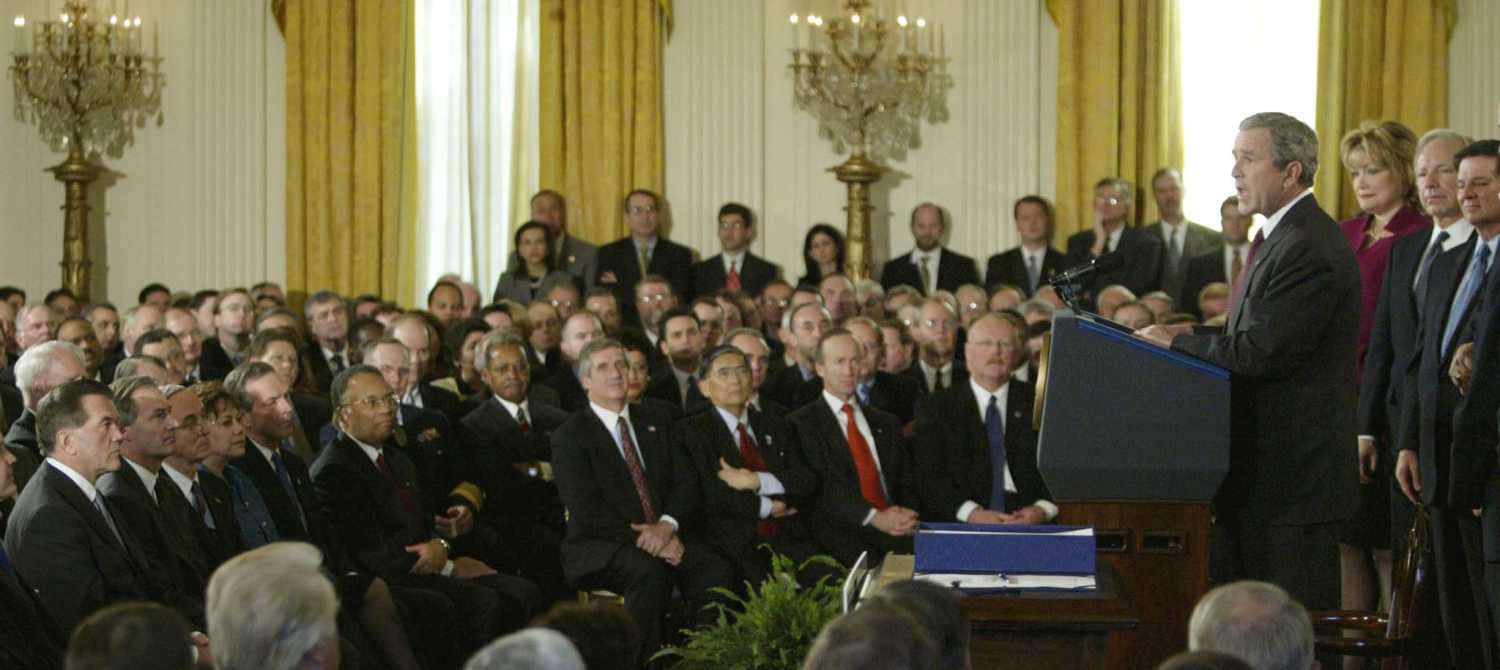
U.S. President George W. Bush (R) speaks during a signing ceremony tocreate the Department of Homeland Security in Washington, November 25,2002. White House advisor Tom Ridge (L), Asa Hutchinson (2nd L), thehead of the Drug Enforcement Administration and Navy Secretary GordonEngland (3rd L) listen to the President. Bush picked Ridge to be thedepartment's first secretary and said he would nominate England to bethe deputy secretary and Hutchinson to be undersecretary of border andtransportation security. REUTERS/Gary HershornGMH/ME
  • 7 min read

20th anniversary 9_11 graphic (1)In the aftermath of 9/11 everyone, from elected officials and national security experts to ordinary citizens had one question: how could this happen to a nation with such an enormous and expensive military and intelligence architecture? The question was so ubiquitous that (in spite of some foot dragging by the Bush Administration) it eventually led to the creation of a high-level commission charged with seeking answers. Two and a half years after the attacks, in the summer of 2004, the Commission finished its work and released its report. The overriding conclusion was that the government’s principal failure in 9/11 was a failure to “connect the dots.” [1] What that meant was that pieces of the puzzle were to be found in many corners of the U.S. government but that no one connected the dots well enough or in a timely enough manner to predict with sufficient accuracy the attack that came.

“The overriding conclusion was that the government’s principal failure in 9/11 was a failure to ‘connect the dots.’”

The report listed in depth the many failures that prevented the government from seeing what was coming. They cut a swath across the vast United States government. The State Department was in charge of visas but failed to catch the fact that several of the visas and passports of the hi-jackers were manipulated in a fraudulent manner. The FBI had the responsibility of keeping track of bad guys inside the United States while the CIA had the responsibility of keeping track of bad guys outside the United States. So two of the terrorists were tracked as they moved internationally (Nawaf al-Hazmi and Khalid al-Mihdhar) but tracking responsibility was not handed over to the FBI once they landed in the United States. Even when they were tracked and arrested, as when Zacarias Moussaoui was, he was charged with immigration violations.  However, what brought him to the attention of the FBI—taking flight lessons for the purpose of using an airplane for an attack (he had no interest in learning to land the plane)—was not passed up the chain of command and not linked to the possibility of a broader plot. The Navy had its own intelligence system. And information that linked the attacks on the Navy ship the Cole to one of the 9/11 hi-jackers and to Al-Queda was missed. The FAA was in charge of airline security as well as security at airports. And yet no-fly lists were not updated with the names of terrorists, passengers identified by the airlines’ own system were not checked and aircraft cockpit doors were not hardened.

In the lead up to 9/11, the government was collecting vast amounts of data but failing to make sense out of it. Every day the U.S. government was collecting vast amounts of information via its satellites. And yet there were years of conversations waiting to be translated and years of photographs waiting to be looked at. Eight years after 9/11 the problem persisted—including huge backlogs and a shortage of translators.

There were other failures as well. The entire intelligence community was built to follow the Soviet monolith and it was moving at a glacial speed to try and adapt to the new threats posed by asymmetric warfare. For instance, it was laden with Russian speakers and disastrously short of Arabic speakers. According to one former intelligence community officer, speaking a few years after the attack, “…to a certain extent, the Soviet Union is still alive and well in the cultures and in the bureaucratic authorities of the IC.”

Finally, the 9/11 attacks signaled a change in the very nature of terrorism. Instead of being linked to concrete political goals, the new Islamic version welcomed mass casualties and did not shy away from killing non-combatants. Gina Bennett, a young state department analyst was one of the first American intelligence professionals to describe Osama bin Laden and his world view and she admitted that what she was describing “… wasn’t considered ‘normal’ in the world of counterterrorism.”[2]

“In the aftermath of 9/11 pressure built for change and policy makers started creating new organizations.”

In the aftermath of 9/11 pressure built for change and policy makers started creating new organizations. In November 2001, Congress created the Transportation Security Agency which federalized airport security which had been largely in the hands of private contractors to the airlines. In late 2002, Congress passed the Homeland Security Act which combined 22 organizations into the first new Cabinet Department since 1989. A combination of factors—the failure to find weapons of mass destruction in Iraq, criticisms raised during the 2004 presidential campaign and intense pro-reform lobbying by the families of victims of 9/11—resulted in passage of the Intelligence and Reform and Terrorism Prevention Act of 2004. The legislation created a new office, the Office of the Director of National Intelligence (ODNI) which was to “coordinate” the FBI, the CIA and the 14 other agencies that made up the U.S. intelligence community. And it established the National Counterterrorism Center to analyze and integrate all intelligence and threats to Americans at home and abroad. The law was an attempt to make the boundaries between domestic and international intelligence that had contributed to the nation’s inability to disrupt the 9/11 attacks more porous.  But it also raised concerns about privacy and civil liberties. Thus, the law also created the Privacy and Civil Liberties Oversight Board.

The early organizational changes struck many as orthogonal to the real problems—like moving the deck chairs on the Titanic. The Department of Homeland Security (DHS) in particular, had severe growing pains—becoming at times a dumping ground for political appointees. But the organizational changes suffused the government with the ethos of sharing information that could lead to attacks. National Defense became a truly national function, shared by the cop on the beat as well as by the spy in the souk. DHS and the FBI created information sharing organizations in cities and states.

For much of this time and until his death in 2011, bin Laden dreamed of repeating his 9/11 attacks with another mass casualty attack on the West—as recounted by Peter Bergen in his new book, The Rise and Fall of Osama bin Laden. Attacks were foiled and home-grown terrorists caught and jailed. Even though the ODNI and DHS and the proliferation of counter terrorism centers sounded like a lot of bureaucratic mumbo-jumbo—the front lines of American security were transformed. More intelligence was shared and training was altered.  The border patrol agent, the state department visa specialist, the flight attendant, and the general public (“See something, Say something”) were all on the lookout for trouble.

Intelligence failures still happen, despite protestations to the contrary. It looks like the failure to predict the rapid fall of Kabul, Afghanistan is just the latest. But the U.S. homeland is no longer dependent on one intelligence body. The multi-layered system of government has served us well over the past twenty years, let’s hope it continues.

[1] The 9/11 Commission Report: Final Report of the National Commission on Terrorist Attacks Upon the United States, New York, Norton, 2004, p. 408.

[2] Bergen, Peter, The Rise and Fall of Osama bin Laden, New York, Simon and Schuster, 2021, p. 103.

The Brookings Institution is committed to quality, independence, and impact.
We are supported by a diverse array of funders. In line with our values and policies, each Brookings publication represents the sole views of its author(s).

Read the whole story
Michael_Novakhov
21 hours ago
reply
http://michael_novakhov.newsblur.com/
Share this story
Delete

The Declassified 9/11 PDBs: questionable sources, skillful placements, warning fatigue as the signs of strategic deception

1 Share

AI Mode Conversation

You said: The Declassified 9/11 PDBs: questionable sources, skillful placements, warning fatigue as the signs of strategic deception

AI Mode reply for The Declassified 9/11 PDBs: questionable sources, skillful placements, warning fatigue as the signs of strategic deception

The Central Intelligence Agency (CIA) released 71 declassified President's Daily Briefs (PDBs) and related intelligence segments covering the period from February 1998 through September 2001.

Key Themes of the Declassified PDBs

  • Long-Term Strategic Warnings: The documents show that U.S. intelligence agencies repeatedly warned executive administrations about Osama bin Laden and al-Qaeda's intentions well before the attacks. For example, a September 10, 1998 memo warned of explosive-laden planes hitting U.S. cities.
  • Questionable Sources: Individual briefings frequently relied on unverified or "highly questionable sources," leading analysts to balance plausible threats against low-confidence reporting. For instance, a July 3, 1998 PDB noted reports from questionable informants regarding looming al-Qaeda plots.
  • General vs. Actionable Intelligence: Much of the data lacked specific tactical details—such as exact dates, times, or specific flight numbers—characterizing the briefings as broad strategic digests rather than actionable operational warnings.
  • Warning Fatigue: Across multiple presidential administrations (Clinton and Bush), the steady stream of generalized, unverified, or non-specific threats contributed to a backdrop of analytical noise and warning fatigue, making it difficult for policymakers to isolate a concrete plot amid constant ambient alarms.
  • Declassified Intelligence Reveals Extensive 9/11-Related Warnings to Presidents - WSJ

    Declassified Intel: CIA released 71 documents (President's Daily Briefs 1998-2001) showing strategic warnings about Osama bin Lade...

  • Long-Sought 9/11 Records Now Declassified and Available to ...

    Sep 11, 2026 — ... and made available to the public for the first time. President's Daily Brief Intelligence Summary – The President's Daily Brie...

  • Don’t Believe the Myth About George Bush’s August 6 9/11 PDB - WSJ

    Myth: The August 6, 2001, President's Daily Brief (PDB) titled "Bin Ladin Determined to Strike in US" provided actionable warning ...

Copied to clipboardFailed to copy to clipboard. Try again later.

Read the whole story
Michael_Novakhov
2 days ago
reply
http://michael_novakhov.newsblur.com/
Share this story
Delete
Next Page of Stories